
- Головна/
- Publications/
- How has the war affected the forestry sector in Ukraine? Regular stakeholders perception
How has the war affected the forestry sector in Ukraine? Regular stakeholders perception

In June, the ForestCom team held a public round table discussion with the State Forest Resource Agency of Ukraine and other stakeholders on "How to improve independent monitoring of the legality of wood harvesting in Ukraine during wartime" during which the participants discussed the situation in forestry and proposed measures to prevent illegal logging from entering supply chains and therefore EU market and elsewhere. One of the recommendations was to publish a list of enterprises that are prohibited from operating. See our full text of the proposals submitted here.
The information base, which can now be used by potential exporters of Ukrainian wood from abroad, includes (in Ukrainian):
-
A list of State Forestry Enterprises that are closed due to the military occupation – link;
-
A list of information datasets open to the public, including the Forestry Tickets Registry and many more – link;
-
Electronic catalog of issued certificates of origin of timber and lumber – link;
-
Сhatbot-style inquiries for those who would like to check the legality of timber products based on additional characteristics (e.g., tag number, truck number, TTN number (waybill), logging ticket number, and Christmas tree tag number) – link.
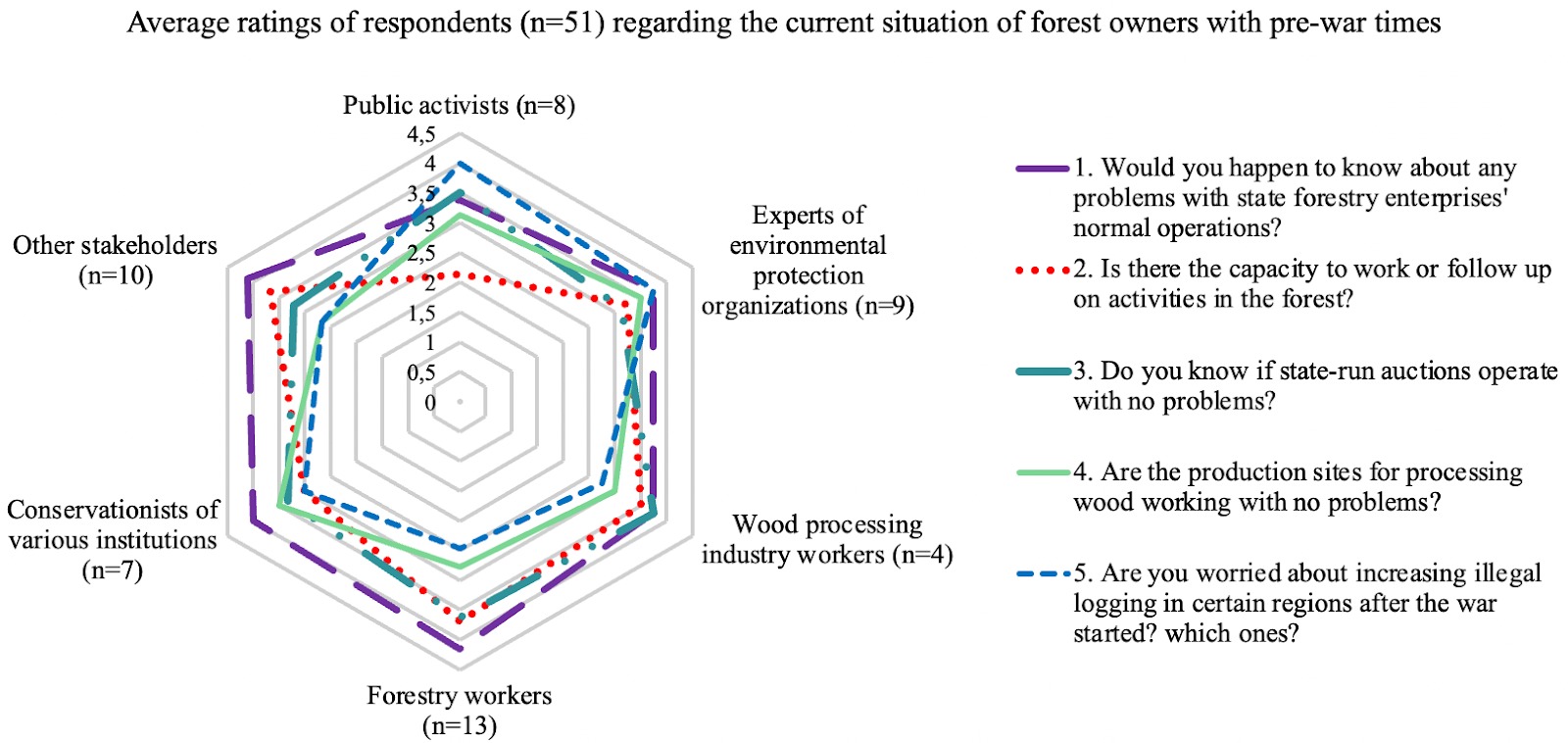
To learn more about the current situation in forestry compared to the pre-war time (before February 24, 2022), the ForestCom team conducted a public survey oriented at experts from the five main stakeholder groups (n=51), e.g., public activists (n=8), experts of environmental protection organizations (n=9), forestry workers (n=13), wood processing industry workers (n=4), conservationists of various institutions (n=7), and other stakeholders (n=10). The survey was conducted in an online format during December 1-13, 2022. The questionnaire consisted of five questions, to each of which it was suggested to rate the impact of the war according to a 5-point of Likert scale format (from 1 - minimum to 5 - maximum value), as well as add a short comment for justification of answers.
1. Would you happen to know about any problems with state forestry enterprises' normal operations?
The majority of respondents (66.7%) indicated that the war affected state forestry enterprises’ normal operations. It was rated highest by forestry workers (mean 4.15; standard deviation 0.801) and other stakeholder groups (4.11; 1.488).
2. Is there the capacity to work or follow up on activities in the forest?
Respondents' answers were divided regarding the capacity to work or follow up activities in the forest: 45.1% indicated that they could work without problems; 29.4% of respondents assessed this possibility as average and 25.4% indicated that they do not have access to the forest. Experts mainly attribute the inability to work or monitor actions in the forest to the ban or restrictions on visiting forests in Ukraine, about which the ForestCom team wrote earlier (more on link), as well as to the unavailability of data and information that would confirm the legality of the harvested wood (for example, LIAC reports). The ability to monitor activities in the forest was rated lowest by public activists (mean value 2.13; standard deviation 1.458).
3. Do you know if state-run auctions operate with no problems?
“Wood trades and auctions are held on schedule and without disruptions” - these are the answers from experts who have information about the work of wood sale auctions and this is 37.2% of respondents. In particular, the respondents pointed to the normal operation of the Prozoro, Edrova portal and licensed wood auctions. Other respondents (more than 50%) indicated that they do not have information about the operation of wood auctions. The highest productivity of wood auctions was rated by wood industry workers (average value 3.75; standard deviation 0.5), which indicates the normal market conditions of the operation of these auctions.
4. Are the production sites for processing wood working with no problems?
Most of the respondents (52.9%) assessed the problem of wood processing enterprises as unchanged compared to the pre-war time. At the same time, experts-wood processing industry workers noted that the main problems they are currently facing are: 1. Problems with electricity supply. Therefore, the amount of wood that can be processed is limited; 2. Surplus wood. Although at a high price; 3. Non-reimbursement of VAT; 4. Increase in fuel prices, which affects the cost of production; 5. Reduction of the forest area certified by the FSC system (for example, in the Sumy region); 6. Destruction of logistics routes. Companies that focused on the market of China, India, Turkey, and other southern countries lost these markets as a result of blocking the seaports and were forced to either stop work or refocus on the EU markets; 7. Military mobilization of personnel (wood industry workers). Experts of environmental protection public organizations (mean value 3.50; standard deviation 1.069) and conservationist of various institutions (mean value 3.50; standard deviation 0,837) assessed the problems of wood processing enterprises the highest , while other stakeholder groups (2.67; 1.408) and forestry workers (2.77; 0.599) - assessed these problems the lowest.
5. Are you worried about increasing illegal logging in certain regions after the war started? which ones?
Regarding the trends in the scale of illegal logging in Ukraine, 39.2% of respondents indicated an increase of illegal logging facts, and 33.3% - such facts are unknown. The rest (27.5%) of respondents indicated that the situation remains similar compared to the pre-war time. The respondents indicated that illegal logging mostly happens on the temporarily occupied territories of Ukraine. Also, the energy crisis affected the increase in the need for firewood among the population, thus provoking an increase in illegal logging. As before the war, cases of illegal logging of forest protection belts, single trees, abandoned gardens, and self-seeded forests are recorded. At the same time, some report about decrease in illegal logging due to strict control on highways. Public activists (mean 4.00; standard deviation 1.414) and experts of environmental protection public organizations (3.75; 1.389) rated the increase in illegal logging the highest, while forestry workers rated this fenomena the lowest (2.46; 1.266).
Thus, respondents from all surveyed groups agreed that the war had a negative impact on all the mentioned aspects of the forestry sector in Ukraine but mostly on the “normal” operation of the forestry enterprises.
The most interesting information can be found in the original answers presented in the attached presentation.