
- Головна/
- Publications/
- Revised FSC Risk Assessment for Ukraine: Key Changes for the Forest Sector
Revised FSC Risk Assessment for Ukraine: Key Changes for the Forest Sector
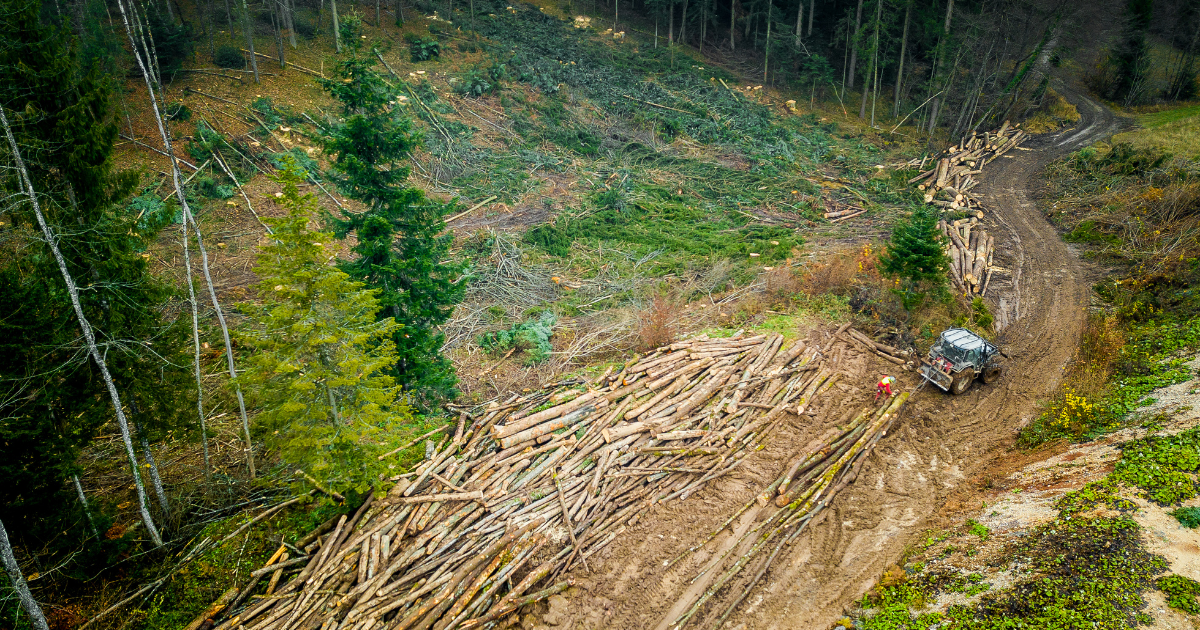
FSC International has released a revised Risk Assessment for Ukraine (RA Ukraine) - a document that defines the conditions under which timber sourced from Ukrainian forests is considered acceptable for FSC-certified supply chains New risk assessment strengthens responsible sourcing in Ukraine | fsc.org.
Given the upcoming EU Deforestation Regulation (EUDR) – scheduled to take effect in 2027 and requiring operators and traders to demonstrate that their products are not linked to deforestation or forest degradation – combined with the impacts of Russia's full-scale invasion, Ukraine's forest sector faces mounting regulatory and operational pressure. Because a large share of Ukraine's timber output is closely integrated into EU supply chains, navigating these dual pressures is essential for market access.
In this context, the voluntary Forest Stewardship Council (FSC) certification system remains one of the primary internationally recognized mechanisms for confirming that timber products meet legal origin requirements as well as strict environmental and social standards. The foundation for implementing FSC in Ukraine is its risk assessment. The newly approved version – FSC Risk Assessment for Ukraine (FSC-RA-UKR-03-2026) – replaces the previous FSC National Risk Assessment for Ukraine (FSC-NRA-UA V2-0), which had been in force since 2022.
The draft was developed by an expert group from the NGO "Forest Initiatives and Communities" (ForestCom), comprising approximately 30 specialists in natural sciences, law, and economics. The team worked under the scientific and methodological guidance of Dmytro Karabchuk and Tetiana Pyvovar, with support from FSC Ukraine.
The methodological basis was the FSC Risk Assessment Framework (FSC-PRO-60-006b), which the team adapted to the specific conditions of Ukraine's forest sector – most notably addressing the impossibility of applying traditional, static territorial zoning amid active hostilities and landmine contamination.
The revision process ran from 15 August 2024 to 30 July 2026. More than 160 representatives from 118 institutions and organizations (including government bodies, businesses, research institutions, civil society organizations, and international partners) participated in the public consultation, submitting 85 substantive comments. Of these, 65 were fully incorporated, and a further 12 were partially adopted.
Compared to the previous version, the main distinction of FSC-RA-UKR-03-2026 is that it analyzes a broader set of 64 economic, social, and environmental risk indicators (described in detail in our earlier publications, linked below). Under the updated FSC methodology, each indicator is evaluated individually for each of four distinct source types. This allows a single indicator (such as respect for land-use rights) to carry a different risk designation depending on the specific territory to which it applies.
Additionally, terminology has been updated to align with the current FSC methodology. Instead of "Specified risk" and "Low risk," the document now uses: "Non-negligible risk" (significant risk), "Negligible risk" (minor risk), and "Not applicable."
Classification of timber source types under wartime conditionsThe dynamic nature of the front line and the ongoing risk of rapid explosive ordnance contamination made FSC's traditional static spatial zoning unviable. In its place, a framework based on four source types was introduced. Each source type carries its own verification procedure and requires a reassessment of the forest operator's territory before each stage of the certification process:
|
Another key feature of the new document is the depth of factual justification supporting each finding, featuring both brief and extended explanations with references to primary sources and current statistics.
Key data points in the document include:
-
official statistics record an illegal-logging rate of 0.3%, while available evidence points to systematic underreporting of this figure relative to the real scale of harvesting violations – this is likewise classified as a non-negligible risk;
-
for temporarily occupied territories, nearly all legality indicators receive a "non-negligible risk" status, since objective verification of legal compliance in these territories is not possible.
Ultimately, FSC-RA-UKR-03-2026 is methodologically modernized and empirically grounded. It addresses the unique operational realities of Ukraine’s forestry sector during wartime while preserving the ability to certify timber in areas unimpacted by active conflict – thereby enabling ongoing business operations.
By shifting toward territorially differentiated indicator assessments and incorporating factual data through 2025, the framework vastly improves risk precision. For the forestry sector, this necessitates adapting internal compliance procedures to the logic of source-type classifications well ahead of the EUDR’s 2027 enforcement date.
“Moving to an assessment at the level of each individual indicator and territory is not merely a technical refinement of FSC methodology in response to wartime challenges – it is a fundamental shift in forest policy logic,” notes Dmytro Karabchuk, PhD, forest policy expert.
“This approach aligns our risk-assessment framework directly with the logic built into the EU Deforestation Regulation, where compliance applies not just to a country overall, but to a specific land plot, supplier, and indicator. For Ukraine’s forest sector, this presents both a challenge–requiring far more precise geospatial and consignment data–and a major opportunity. Companies that genuinely comply with these specifications will enjoy a distinct competitive edge in EU markets over competitors operating in higher-risk zones.”
Related publications:
- Public Consultations on FSC Risk Assessment for Ukrainian Timber) https://forestcom.org.ua/en/news-post/public-consultations-fsc-risk-assessment-ukrainian-timber
- Webinar on the FSC Project for National Risk Assessment (NRA) of Controlled Timber in Ukraine – https://forestcom.org.ua/en/news-post/vebinar-nor
- FSC Risk Assessment in Ukraine: Explaining Complex Topics Simply– https://forestcom.org.ua/news-post/ocinka-ryzykiv-fsc-v-ukrayini
- Public Consultations on FSC Risk Assessment for Ukrainian Timber – https://forestcom.org.ua/en/news-post/public-consultations-fsc-risk-assessment-ukrainian-timber