
- Головна/
- Publications/
- Illegal Timber Supply Chains: Why Logging Is Only the Beginning
Illegal Timber Supply Chains: Why Logging Is Only the Beginning
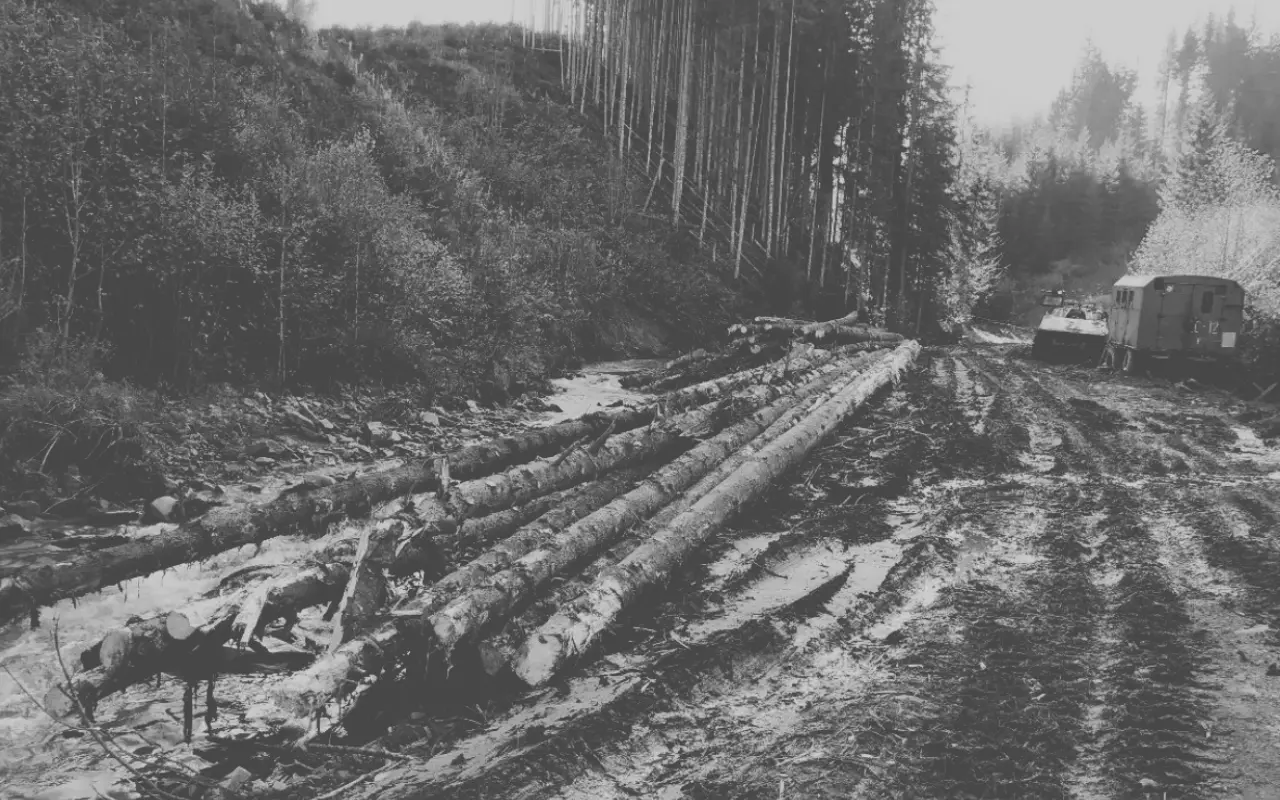
What do illegal logging operations usually bring to mind? People with chainsaws cutting down trees deep in the forest, freshly cut stumps, and forest soil torn up by vehicle tracks. Yet this is only the first stage of a much larger and more complex system. The illegal timber market is an entire supply chain that includes transportation, storage, processing, and sale of illegally harvested wood. It is at these stages that illegally logged timber becomes a market commodity capable of generating enormous profits. However, when it comes to combating such schemes, Ukrainian legislation remains largely ineffective.
Once trees are cut, the timber must be transported out of the forest, delivered to storage sites or sawmills, processed, and eventually sold. This process involves dozens of actors — drivers, intermediaries, warehouse owners, sawmill operators, and wood-processing businesses. Without this infrastructure, the illegal timber market could not exist. Nevertheless, criminal liability in Ukraine is still focused almost exclusively on the act of illegal logging itself.
To hold offenders accountable, law enforcement agencies need more than simply discovering timber without documentation. They must prove the timber’s illegal origin. In practice, this means identifying the exact location in the forest where the transported or stored trees were illegally cut down. In reality, this is nearly impossible.
Why It Is So Difficult to Punish Offenders
When law enforcement officers stop a truck carrying undocumented timber, their options are extremely limited. At most, they can seize the cargo and initiate criminal proceedings. However, unless they can prove that the driver or owner of the cargo personally participated in the illegal logging operation, punishment is usually avoided.
The same problem applies to timber storage sites and sawmills. Even if authorities discover timber of suspicious origin on the premises of a business, this alone is insufficient for prosecution. Investigators still need to establish a direct link between a specific batch of timber and a specific illegal logging site.
As a result, the system functions effectively only when offenders are caught in the act of logging or when law enforcement agencies conduct long-term surveillance of organized criminal groups. In most cases, illegally harvested timber successfully moves through the entire supply chain — from the forest to finished products — without any real risk of punishment for those involved.
Why Legislative Changes Are Crucial
Experts emphasize that combating illegal logging effectively is impossible without regulating the entire timber supply chain. This requires legislation that makes documentation proving the legal origin of timber mandatory at every stage — transportation, storage, processing, and sale.
Under such a system, the absence of proper documentation itself would become sufficient grounds for liability, without the need to identify the precise logging location in the forest. This would allow law enforcement authorities to intervene not only during illegal logging operations, but also during transportation and commercial distribution of timber.
Similar approaches have long been implemented in many countries around the world, where traceability and origin verification systems are considered key tools in fighting illegal logging.
This is why efforts to combat illegal logging cannot be limited to catching people with chainsaws in the forest. Without accountability for transportation, storage, and processing of illegal timber, the market will continue to remain economically profitable and largely unpunished.
NGO “ForestCom” supports clearer and more specific liability provisions for forestry-related offenses. In particular, this includes clearly defining criminal and administrative offenses related to the transportation, storage, and sale of trees, shrubs, or timber without documents confirming their legal origin. The same should apply to the use of forged documents, documents obtained illegally, or documents containing deliberately false information on a significant scale.
We also consider it necessary to increase fines and penalties so that punishment for environmental crimes — especially those involving illegally harvested timber — becomes inevitable.
The publication is produced by NGO «ForestCom» with the support of the Askold and Dir Fund as a part of the Strong Civil Society of Ukraine – a Driver towards Reforms and Democracy project, implemented by ISAR Ednannia, funded by Norway and Sweden. The contents of this publication are the sole responsibility of NGO «ForestCom» and can in no way be taken to reflect the views of the Government of Norway, the Government of Sweden and ISAR Ednannia.