
- Головна/
- Publications/
- Ways to strengthen the ecosystem services of forests to increase the amount of carbon dioxide absorption and mitigate the climate change effect
Ways to strengthen the ecosystem services of forests to increase the amount of carbon dioxide absorption and mitigate the climate change effect

Forests are is a unique ecological system and at the same time are a source of renewable resources and useful functions that provide numerous ecosystem services, supply of timber and non-timber forest products. Forests serve as a natural ecological framework in landscapes, play a key role in regulating global processes in the surrounding natural environment, prevent climate change, and contribute to the conservation of water resources and biodiversity.
The role of forests as a major terrestrial sink for greenhouse gases (GHG) and one of the most important ecosystem factors for mitigation and adaptation to climate change has been internationally recognized, and in this regard, Ukraine's forestry has a significant potential to reduce climate change risks, which still remains underestimated and unrealized.
At the 21st session of the Conference of the Parties to the UN Framework Convention on Climate Change (Paris, 2015) in the context of sustainable development, a transition to a "low-carbon economy" model was declared, which is able to resist climate change, provided that the potential of forests to prevent climate change by absorbing GHG is used (primarily carbon dioxide) and retention of carbon in forest ecosystems.
Forest vegetation naturally removes carbon from the atmosphere through photosynthesis, which turns carbon dioxide into organic matter that accumulates in forest biomass. The main terrestrial GHG sinks in Ukraine include:
● forests on the lands of the forest fund (10.4 million hectares),
● perennial plantings on agricultural land (0.9 million ha),
● green plantings in settlements (0.7 million ha),
● agroforestry and protective plantations - shelterbelts, erosion control strips, etc.(0.4 million hectares),
● self-seeded forests (0.3-0.5 million hectares).
Carbon in forests is contained in stands, understory vegetation (shrubs and ground vegetation), dead organic matter, and soils. According to international requirements (IPCC 2006 Guidelines...), carbon in forest ecosystems should be accounted for the following pools:
1. Aboveground phytomass.
2. Underground phytomass.
3. Dead wood.
4. Forest litter
5. Soil organic matter.
The indicated carbon pools are characterized by the following features (table):
Table. Characteristics of carbon pools in forests
|
Carbon pool |
Characteristic |
|
|
Live biomass |
Above ground |
All biomass of both woody and herbaceous living vegetation above the soil surface, including trunks, stumps, branches, bark, seeds and leaves. Measured in tonnes of dry matter. |
|
Underground |
All living root biomass, except for fine roots (diameter < 2 mm), which cannot be distinguished from soil or litter organic matter. |
|
|
Dead organic matter |
Dead wood |
All dead woody biomass that is not contained in the litter and is above ground or in the soil. The dead wood pool includes dead roots and branches with a diameter > 2 cm and stumps with a diameter of 10 cm or more. |
|
Litter |
All dead biomass of plant origin, which includes leaves, leaf remains, fruit remains, fine roots (< 2 mm) and twigs < 2 cm, located on the soil surface. |
|
|
Soils |
Soil organic matter |
Includes organic carbon in mineral soils up to a depth of 30 cm. Organic remains of plant and animal origin, which cannot be separated, are included in the soil organic matter. |
The methodology of national reporting for the sector of Land Use, Land-Use Change and Forestry (LULUCF) and the requirements for accounting for emissions and absorption of greenhouse gases by forests are set out in the Guidelines of the UN Intergovernmental Panel on Climate Change (IPCC) on effective practices for land use, land use change and forestry and in additions to them (2006, 2014). The UN IPCC Guidelines for National Greenhouse Gas Inventories in LULUCF include three methodological levels of accounting and GHG inventory preparation:
1. Use of conversion factors given in the IPCC guidelines for climatic zones.
2. Calculation using simple equations and national conversion factors.
3. Use of modern methods, including mathematical modelling, and detailed national data.
According to the current international methodology for accounting for greenhouse gases (IPCC Guidelines for National Greenhouse Gas Inventories, 2006), carbon sequestration in living biomass is taken into account only in perennial tree stands and only in those components that are long-term carbon sinks. When determining biomass growth, leaves (needles) and living ground vegetation are not taken into account.
The annual change in carbon stocks in a specific pool can be calculated in two ways:
1. As a function of carbon changes and losses.
2. As a function of changes in the carbon stock, which is set for a certain time interval, based on the results of successive evaluation of the carbon stock.
According to international agreements (Marrakesh Accords, 2001), annual national reporting must reflect information and assess changes in carbon storage in all five pools. This is due to the fact that a decrease or increase in the carbon stock in one of the pools can be compensated by an increase or decrease in the other. For example, the above-ground phytomass pool decreases after fires or damage by insect pests, while the deadwood pool increases. Therefore, in order to ensure transparent reporting, a necessary condition is the calculation of the total value of the increase or decrease of carbon stocks in the specified area for all five carbon pools, which allows establishing the carbon balance for a specific area.
The carbon balance in the forest is a dynamic parameter that largely depends on the age structure of forest stands. A change in the age structure (increasing the age of forests) affects the value of the carbon balance of the forest area. As of 2011, nearly 800 million tons of carbon were accumulated in the forests of Ukraine (A.Z. Shvidenko, et al., 2014). Annually, the forests of Ukraine absorb 5-7% of the total amount of greenhouse gas emissions (with an average level of forest cover in the country of 15.9%). In the European Union, the absorption of greenhouse gases by forests is about 10% (with an average level of forest cover of 42%). The high level of GHG absorption at a relatively low level of forest cover in the country is explained by the fact that the share of hardwood species (which store more carbon compared to coniferous and soft-leaved species) in the forest fund of Ukraine is relatively higher than in the forests of the European Union. In addition, the content of organic matter and, accordingly, the specific share of carbon in Ukrainian forest soils is on average higher than in the soils of European countries.
In the sector of Land Use, Land-Use Change and Forestry (LULUCF) until 2018, absorption of greenhouse gases exceeded sectoral emissions, that is, the sector was a net absorber (Ukraine's greenhouse gas inventory 1990-2019). For the first time in the entire period of reporting to the UN Framework Convention on Climate Change (UNFCCC)in 2018 the volumes of sectoral emissions exceeded the volumes of GHG absorption. This is due to the fact that the age structure of forests changes over time, there is an increase in the average age of forest stands and, accordingly, a decrease in the annual growth in biomass and the amount of carbon sequestration. In addition, there was an increase in the loss of accumulated carbon in the forest fund due to the loss of forest biomass due to an increase in the number and area of forest wildfires, an increase in the area of pest and disease foci, and an increase in the volume of logging. Therefore, the maintaining of accumulated carbon stocks in forest stands is one of the main measures to strengthen the ecosystem functions of forests, which are aimed at mitigating climate change effects. It is important to maintain forests, self-forested areas, and especially old-growth forests.
Over the past thirty years, the average annual number of forest wildfires in Ukraine has more than doubled, and the area of foci of forest pests and diseases has also increased significantly – by 40-50% over the past twenty years compared to the period 1980-2000. Forest fires were the main cause of trees mortality in 2020. In 2018-2019, the average area of wildfires was 2,250 hectares forground fires and 414 hectares forcrown fires. During 2020, Ukraine experienced a number of particularly large forest fires in Polissia and Eastern Ukraine, which caused unprecedented environmental, social and economic damage.
The loss of stored carbon due to forest fires is a major problem preventing effective mitigation of climate change. Therefore, it is necessary to improve the fire protection of forests, the methods of operational fire extinguishing, and to implement the rapid removal of wood from burned areas to prevent its depreciation and avoid further economic losses.
Emissions from fires are divided into actual fire emissions, which occur during the burning of plant materials, and post-fire emissions, which occur as a result of the decomposition of vegetation killed by fire. The scale of these emissions is completely determined by the size of the area and the degree of fire damage to the forest vegetation. In order to estimate with a certain level of accuracy the emissions from fires and to predict their increase/decrease in case of implementing or not implementing successful fire prevention strategies, it is necessary to conduct special studies that will cover the whole range of damage to forest stands caused by fires.
Reducing the scale of fire danger in forests can be ensured thanks to the implementation of a set of measures for the prevention of fires, increasing the efficiency of their detection and extinguishing. One of the ways to reduce the probability of occurrence of forest fires, to weaken their intensity and to slow down the speed of their spread, as well as to increase the efficiency of extinguishing and reduce the consequences, is to reduce the amount and change the location of forest combustible materials (FCM), or more precisely, to break the vertical and horizontal continuity of FСM. It can be achieved through thinning and understory and undergrowth cutting. Timely thinning ensures an increase in the distance between tree crowns, which reduces the possibility of fire spreading from one crown to another. Increasing the fire resistance of forests should also be ensured by regulating the species composition of stands. The presence of one unit of deciduous species in the composition of pine forests reduces the risk of fire occurrence by 10–15%, and 2–3 units – by 30–50%. Considering this, pine forests in Ukraine should be transformed from pure single-aged forests to mixed ones with the participation of deciduous species, taking into account forest site conditions. To strengthen energy independence, the approaches to the transformation of forest combustible materials into biofuel are promising, thus two strategic goals can be achieved at once: strengthening the energy independence of territorial communities, and reducing fire danger in the most vulnerable sites.
A significant contribution to the reduction of greenhouse gas emissions can provide improved protection of forests from insect pests and diseases. During 2017-2021, significant deterioration of forests health condition and dieback of forests took place most intensively in 2017 and 2020. According to the State Statistics Service of Ukraine, the area of dead forests exceeded 20,000 hectares in 2017 and reached almost 40,000 hectares in 2020. It is very likely that the deterioration of the health condition of forests occurred as a result of climatic anomalies of recent years. Such manifestations of climate change as a long absence of precipitation in the growing season, an increase in its share in the winter period, a spatial and temporal redistribution of precipitation compared to the long-term norm, an increase in average air temperatures lead to an increase in the level of fire danger in the forests of Ukraine.
The volume of timber harvesting in the forests of Ukraine from the 90s of the last century to 2000 annually amounted to 12-14 million m3, in subsequent years had a steady upward trend (in 2015-2018 exceeded 22 million m3), in 2019 amounted to 21 million m3 per year, and in 2020 - 18 million m3. These trends are mainly related to the change in the age structure of forests and the deterioration of their health condition.
During the reporting period to the UNFCCC, the balance of emissions and absorption of GHG in the LULUCF sector has changed significantly, primarily due to an increase in emissions from cultivated agricultural land (arable land). The total volumes of GHG absorption in the forest fund compared to 1990 decreased only by 8%, while GHG emissions from arable land tended to increase from 31.3 million tons of CO2-eq. in 1990 up to 50 million tons of CO2-eq. in 2019. GHG emissions from arable land and pastures largely depend on management practices and weather conditions. Significant amounts of organic fertilizer application ensured lower GHG emissions in the early 1990s. In 2018, only 5% of organic fertilizers were applied from the level of 1990, and about 88% of mineral fertilizers. In addition, the structure of sown areas has changed significantly - against the background of a slight increase in the share of cereals, the share of industrial crops (sugar beets, flax, hemp) has decreased significantly (from about 35% to 10%) and the share of oilseeds (sunflower, rapeseed, soybeans) has increased significantly from about 7% to 30%. These changes led to the fact that in 2018 GHG emissions in the LULUCF sector exceeded the sectoral absorption.
If we consider the GHG absorption potential only for the lands of the forest fund, then according to the official national reporting of Ukraine to the UNFCCC (Ukraine's Greenhouse Gas Inventory 1990-2020. - Kyiv 2022) from 1990 to 2020, the amount of carbon dioxide absorption varied from 51.8 million tons of CO2 eq. in 1999 to 24.4 million tons of CO2 eq. in 2016, and for the last 5 reporting years (2016-2022), the amount of annual absorption amounted to an average of 26.5 million tons of CO2 eq., or an average of 2.55 tons of CO2 eq. per hectare of forest land. The given figures show that forestry in Ukraine is the only sector of the country's economy that absorbs more carbon than it emits. This important circumstance should be properly understood in society, reflected in legislative and regulatory acts and become a valid argument when making decisions regarding the provision of state support for the functioning of the forest industry. Unfortunately, in Ukraine, at the national level, attention was mostly paid to the issue of reducing emissions in the thermal power industry and industry, while GHG absorption in forestry has so far been left out of due attention.
The situation has changed somewhat with the adoption of the State Strategy on Forest Management of Ukraine until 2035, approved by the order of the Cabinet of Ministers of Ukraine No. 1777-р on December 29, 2021, which provides for the achievement of the goal of increasing the level of absorption of greenhouse gases by the forests of Ukraine to 75.6 million tons CO2-equivalent through the introduction of sustainable management of forest resources, increase of forest cover to 18%, transition to close-to-natureforestry. In order to achieve the set goal, it is necessary to increase the amount of carbon dioxide absorption by forests by almost 3 times. Considering the large-scale impact on forests as a result of Russia's military aggression against Ukraine, which manifested itself in the fact that about 3 million hectares of the country's forests were damaged (this is about 30% of the country's forest fund area), the area of forest fires in the territories that were under the impact of hostilities, there was a decrease in the capacity of forestry enterprises to carry out measures for the protection and conservation of forests in the conditions of martial law – all these factors significantly affect the volume of GHG absorption by the forests of Ukraine and make it difficult to achieve the goal of increasing the level of absorption of greenhouse gases by forests, defined by the State Strategy on forest management of Ukraine until 2035.
To improve the situation with GHG absorption and carbon sequestration in the system of forestry activities, it is necessary to apply the concept of climate-oriented forestry (Climate-Smart Forestry), which is based on a three-pronged approach, which provides:
1. Maintenance of carbon absorption by forests by optimizing the age and species structure of stands.
2. Strengthening the protection of existing forests against fires, pests and diseases, and applying the principles of close-to-natureforestry.
3. Gradual replacement of energy-intensive industrial products with products made of wood and natural materials, as well as the use of secondary raw materials and biofuel.
Improving the performance of forest ecosystem functions in the absorption of carbon dioxide and carbon sequestration is possible through the development of afforestation on private and communal lands; supporting activities aimed at conducting close-to-natureforestry; optimization of maturity ages; conservation of self-forested and land plots suitable for creating forests; conservation of forests on former agricultural lands.
The most promising type of forestry activity, which ensures an increase in the absorption of atmospheric carbon and its accumulation in terrestrial ecosystems, is the expanded reproduction of forests. The obvious advantage of reforestation and afforestation projects over other types of economic activity in forests is the presence of significant side effects associated with additional timber production, increased employment of the rural population, and improvement of the ecological situation in sparsely forested areas of the country.
Along with the mentioned advantages, afforestation and reforestation projects have significant drawbacks that prevent their large-scale implementation. The main disadvantage is the high initial costs for the creation of forest crops (collection of seeds and growing of seedlings in forest nurseries, soil preparation and planting), as well as the delayed economic effect, due to the relatively slow accumulation of phytomass by forest crops in the first years after their creation.
Significant disturbance of the soil cover is one of the reasons for the increase in GHG emissions during forest management activities. Soil preparation (ploughing) before the creation of forest crops also leads to an increase in GHG emissions. Given the wide range of conditions that affect the volume of GHG emissions due to soil disturbance (different types of soils, a wide range of schemes for their preparation, a variety of cultivation techniques, etc.), reliable estimates of the volume of GHG emissions can be made for specific conditions by conducting targeted studies.
In order to reduce these shortcomings, it is necessary to apply an adapted technology of creating forest crops, which in particular involves minimizing soil cultivation, using planting material with a closed root system, and using natural regeneration.
In order to increase absorption and reduce emissions, a gradual transition to non-clear final feelings is necessary, where it is expedient with the provision of additional stimulating measures; ensuring the optimal age structure of forest stands, optimizing the ages of maturity. Currently, in Ukraine, the age structure of stands of the main forest-forming species does not correspond to the theory of a normal forest, since there is a significant lack of young and mature stands with a predominance of middle-aged and mature stands. The highest intensity of carbon absorption is characteristic of middle-aged stands (3.5–6.5 t C/ha per year). It is somewhat lower in young stands, mature forests, and in reforested cutting areas it is 0.1 to 0.7 t C/ha per year.
To optimize the species composition and age structure, it is necessary to provide the following measures:
● improving maturity ages by differentiating them taking into account the origin, condition and productivity of forest stands;
● planting of mixed forest crops in cutting areas, promoting natural regeneration;
● reconstruction of low-value stands;
● optimization of the species composition during felling of formation and improvement of forests.
In recreational, health and protective forests, it is advisable to focus on ecological maturity, one of the indicators of which is carbon dioxide absorption. Based on the capacity of carbon accumulation, the age of ecological maturity is close to the age of technical maturity for coarse industrial wood, which is connected with the achievement of the maximum growing stock by the forest stand at this age.
To improve the accounting of greenhouse gases in the forestry sector, it is necessary to clarify the volumes of absorption (taking into account the age structure of forests and the growth of biomass by natural zones) and the volumes of emissions, taking into account the fact that in damaged forests sanitary felling is usually carried out with the removal of the main mass of affected (damaged) trees. The proportion of damaged wood remaining in the forest can be estimated at 10-15%. Carbon emissions caused by forest damage largely depend on the degree of compliance of forestry management with silvicultural and typological requirements. Improper forestry management (for example, untimely or improper thinning and sanitary felling, formation of stands, the composition of which does not correspond to forest types) usually reduces the resistance of stands and causes an increase in carbon emissions per unit of forest area (Lakyda et al., 2019).
Studies conducted in the countries of the European Union on the assessment of the value of ecosystem services confirm that forests and forest lands are the largest provider of ecosystem services (about 48% of the total value of ecosystem services provided by terrestrial and aquatic ecosystems of 28 countries of the European Union). Their value in 2012 prices was estimated for 28 EU countries in the amount of 81.4 billion euros, while the largest contribution was made by services for recreation, conservation and protection of water bodies, wood supply and carbon sequestration (Accounting for ecosystems..., 2012). At the same time, the value of ecosystem services for carbon sequestration (9.1 billion euros) was about 63% of the total value of wood harvested in the forests of the European Union (Fig).
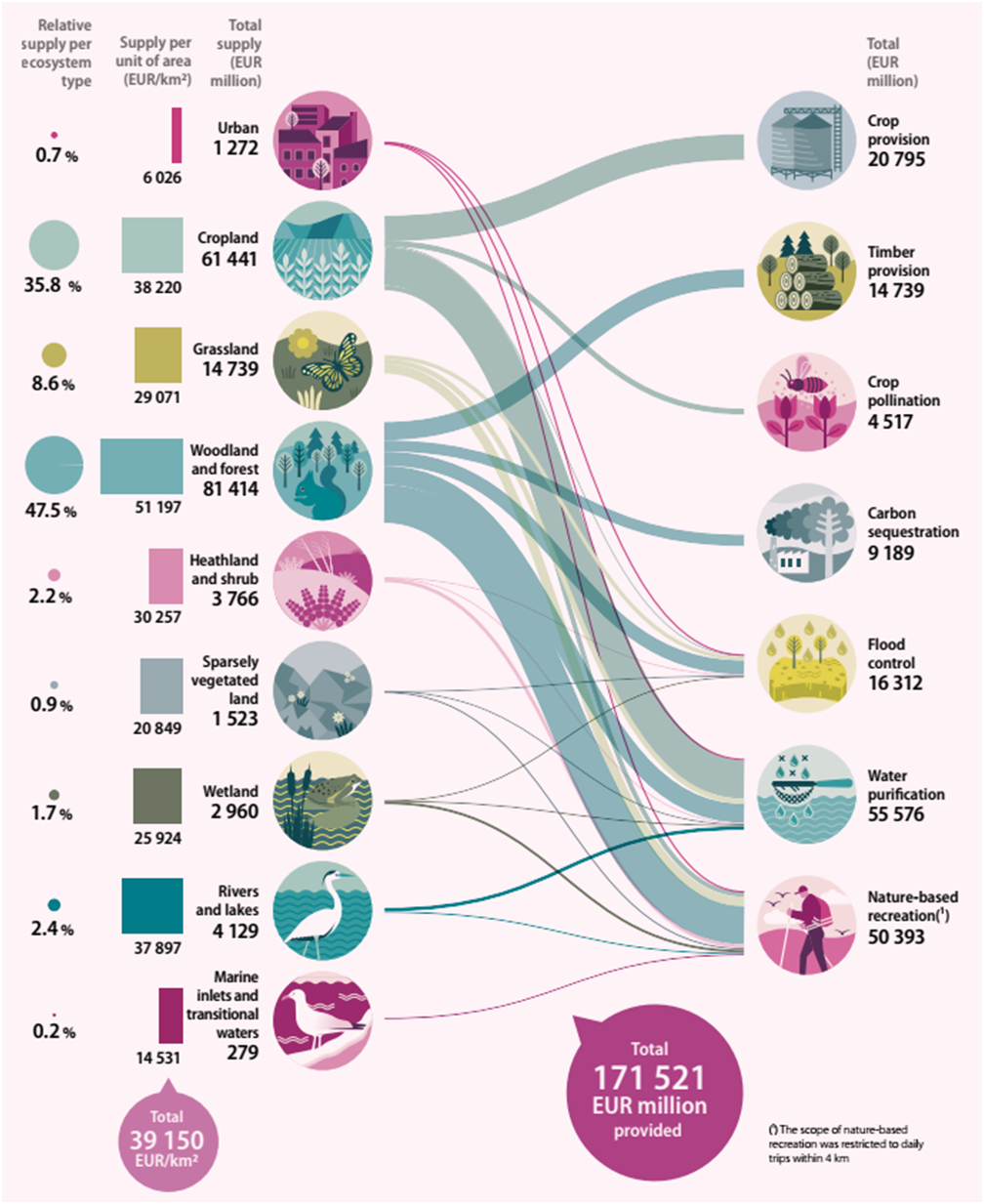
Figure. Key indicators of ecosystem services for 28 countries of the European Union (in 2012 prices) (Accounting for ecosystems..., 2012.)
Conclusions
Forests of Ukraine are one of the most effective natural components of environmental protection, the basis for adaptation of forest and agroforestry landscapes to climate change and an effective means of mitigating the adverse effects of climate change. The ecosystem functions of forests, in particular the absorption of atmospheric carbon dioxide and carbon sequestration, determine their special nature protection role, which is still insufficiently understood by government officials and society in Ukraine, but is part of the EU's pan-European policy in the field of environmental protection and climate change prevention. The formation of an appropriate political profile of forests and the creation of prerequisites for the transition to sustainable forest management in Ukraine are matters of state attention that require the implementation of an appropriate system of measures and can significantly affect the amount of greenhouse gas absorption by the forests of Ukraine and ensure positive changes in the balance of greenhouse gases for the long term. That will contribute to the achievement of the goals of the UNFCCC and the Paris Agreement and increase the chances of avoiding the climate crisis.
References
1. Bioproductivity and energy potential of soft-leaved stands of Ukrainian Polissia: monograph / [P. I. Lakyda, A. M. Bilous, R. D. Vasylyshyn, MatushevichL.M., Makarchuk Y.I.]. Korsun-Shevchenkivskyi: FOP GavryshenkoV.M., 2012. 454 p.
2. Biotic productivity of forests of Ukraine in the European ecoresource dimension / P.I. Lakyda, A.Z. Shvidenko, D.G. Shchepashchenko and others. Bioresources and nature management. 2013. No. 5-6. P. 99-106.
3. Vasylyshyn R.D. Forests of the Ukrainian Carpathians: growth characteristics, biological and energy productivity: monograph. 2016.
4. Vasylyshyn R.D. Forests of the Ukrainian Carpathians: growth characteristics, biological and energy productivity: monograph. 2016.
5. Kobets O.V. Peculiarities of the state, growth and formation of oak stands of the Velyko Andol forest area. Diss. Ph.D. of agricultural science Kharkiv, 2017. 229 p.
6. LovynskaV.M. Bioproductivity of pine stands of the Ravine Steppe of Ukraine. Diss. ... of Doctoral dissertation in the specialty 03.06.02 "Forest management planning and forest evaluation", Kyiv, 2021.
7. Normative and reference materials for the assessment of ecosystem services of soft-leaved forests of Ukrainian Polissia: scientific and industrial reference / A. M. Bilous [et al.], 2017.
8. 2006 IPCC Guidelines for National Greenhouse Gas Inventories Volume 4 Agriculture, Forestry and Other Land Use (access mode: https://www.ipcc-nggip.iges.or.jp/public/2006gl/vol4.html ).
9. Accounting for ecosystems and their services in the European Union (INCA). Final Report from phase II: 2012.
10. Impact of Disturbances on the Carbon Cycle of Forest Ecosystems in Ukrainian Polissya. Lakyda P., Shvidenko A., Bilous A. et al. Forests 2019, 10, 337; doi:10.3390/f10040337.
11. Ukraine’s Greenhouse Gas Inventory 1990-2020, Kyiv, 2022.