
- Головна/
- Publications/
- For what purpose does the US Forest Service grow herbaceous plants at nurseries?
For what purpose does the US Forest Service grow herbaceous plants at nurseries?

The US Forest Service was established in 1905 with a mission to sustain the health, diversity, and productivity of the nation’s forests and grasslands to meet the needs of present and future generations. Over the past 15 years, the traditional role of the Forest Service nurseries has expanded to include the production of a wide range of additional locally adapted plant species to meet the growing demands for ecosystem restoration.
The ecosystems managed by the Forest Service suffer the most from forest fires, pests, diseases, and invasive species. Increased wildfire seasons in the US can be partially attributed to warmer and drier conditions associated with climate change, as noted by Tom Tidwell. Since 2015, wildfires in the US have annually destroyed over 320,000 hectares of forests. However, the Forest Service believes that sometimes large-scale wildfires are deemed necessary for the well-being of the forest ecosystem. Many plants and animals have evolved in response to periodic fires and have adapted to them, and some forests actually require fire to remain healthy.
Expediting the recovery of forest ecosystems after natural disturbances such as fires, windstorms, insect and disease outbreaks, or planned clear-cutting can be achieved through natural or artificial reforestation. [1]
Restoring forests involves restoring the health and resilience of forest ecosystems. In fire-adapted ecosystems, this may involve reducing tree and shrub density, creating a mosaic of different-sized and aged forest patches, and periodic controlled burning of the forest floor. A healthy and resilient forest can serve as protection against the adverse effects of forest fires, especially during prolonged wildfire seasons. [2]
Similar to Ukraine, artificial reforestation is used in the US where natural regeneration is inadequate. Unsatisfactory natural regeneration of the forest often occurs in areas where the seed source has been lost due to natural disturbances such as fires, insect infestations, or diseases.[1]
Artificial reforestation helps shape the optimal forest structure and species composition to provide habitat for wildlife, preserve water quality and absorption, obtain forest products, provide recreational opportunities, stabilize soil, and much more. Reforestation opens up unique opportunities to address new climate-related challenges by preserving and managing the genetic diversity of trees and carbon sequestration to mitigate greenhouse gas emissions.[1]
To facilitate the rapid recovery of ecosystems destroyed by wildfires in the western United States, the Forest Service also grows seedlings of local herbaceous perennials and shrubs at nurseries. For example, they plant sagebrush (Artemisia tridentata) and bitterbrush (Purshia tridentata) with a density of approximately 660 plants per hectare.

John Sloan, assistant manager at Lucky Peak Nursery,
shows off a one-year-old sagebrush seedling grown in containers (photo by Clark Flagge)
These plants fulfill the food and shelter needs of wildlife, especially sage-grouse (Centrocercus urophasianus), which are among the first to return to landscapes after forest fires. Planting local herbaceous and shrub species on burn scars also inhibits the spread of non-native invasive species, such as cheatgrass (Bromus tectorum) and rush skeletonweed (Chondrilla juncea), which can quickly colonize burned landscapes.
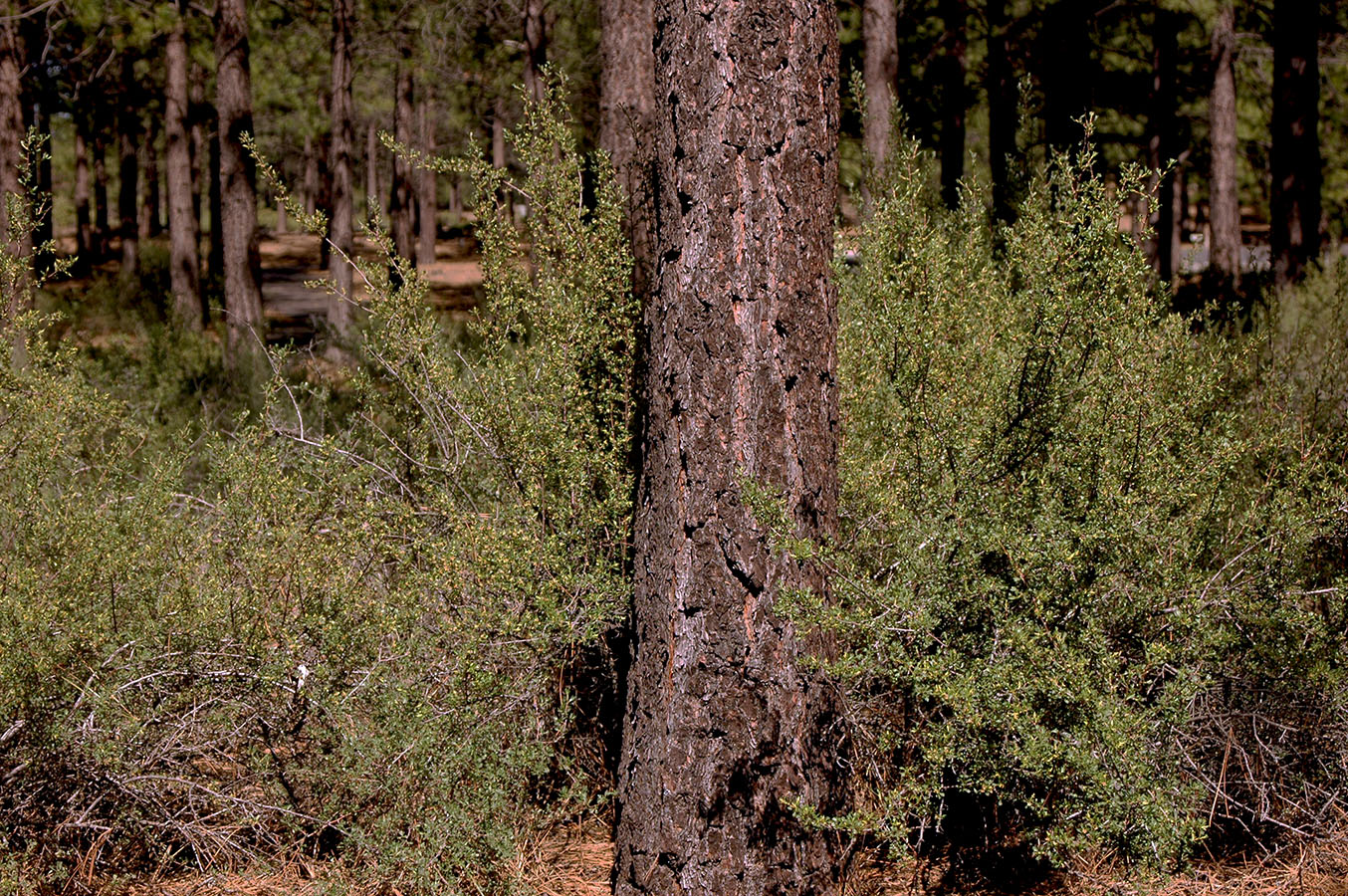
Bitterbrush (Purshia tridentata) is also a crucial species for supporting wildlife in the US. Local rodent species, including pronghorn (Antilocapra americana), black-tailed deer (Odocoileus hemionus), elk (Cervus canadensis), bighorn sheep (Ovis canadensis), and moose (Alces alces), rely on the leaves and shoots of this plant. Bitterbrush is also essential for the survival of local ants, pollinating insects, and rodents.

The habit of porchia in the habitat [4]
Restoring forest ecosystems in the US has become more than just tree planting. For instance, in restoring longleaf pine (Pinus palustris) ecosystems, whose natural range has decreased by over ten times, Forest Service staff work on reintroducing grassland plants, such as wiregrass (Aristida stricta). The grassland understory characteristic of longleaf pine ecosystems, which exhibit high biodiversity, disappeared when other pine species such as loblolly pine (Pinus taeda) and slash pine (Pinus elliottii) were used for reforestation. Restoration efforts now aim to rectify these mistakes and restore valuable ecosystems. [4, 5]
The use of local plant species (herbaceous, shrubs, and trees) in reforestation and ecosystem restoration is an integral part of the broader national goal of conserving biodiversity, health, productivity, and sustainable use of forests, rangelands, and aquatic ecosystems in the United States. [3]
Taras Kharachko,
Manager of the Forest Restoration Center of the NGO ForestCom,"
PhD in Agricultural Sciences.
The article was prepared as part of the activity “Study of International Experience Regarding the Analysis of the Impact of Global Climate Change on Forest Ecosystems and Their Restoration," which is an integral component of the project "Fighting Illegal Logging in Ukraine Program" supported by the USFS International Programs Office.