- Головна/
- Publications/
- Climate Adaptation Marathon: Become the Voice That Unites!
Climate Adaptation Marathon: Become the Voice That Unites!
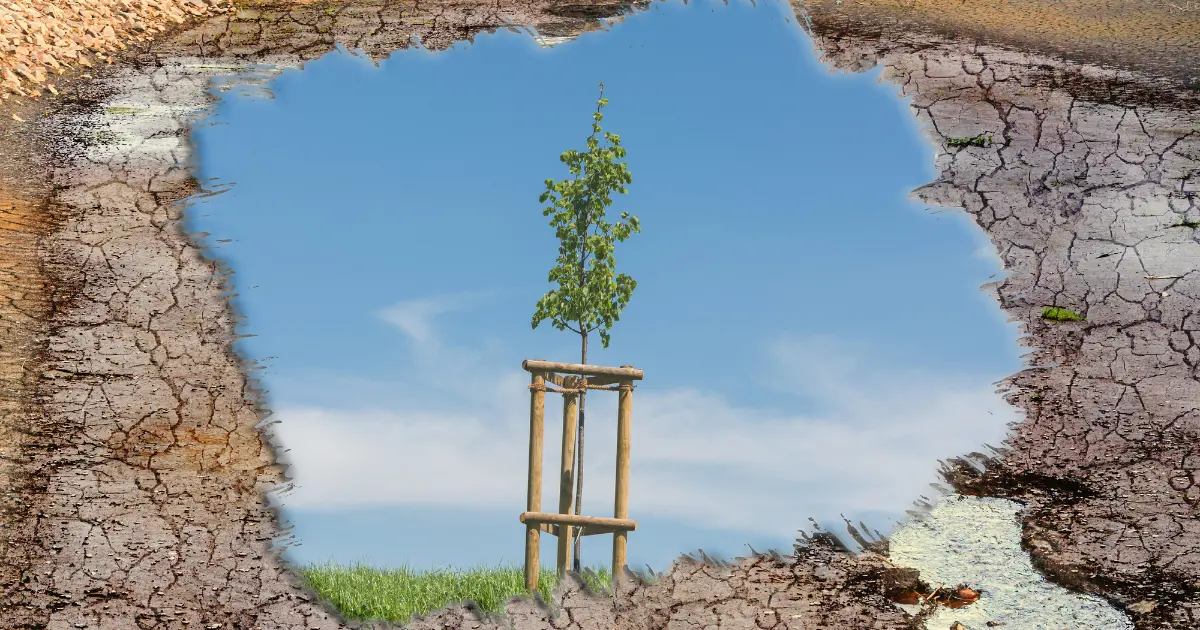
When a biologist observes a forest, they see a complex network of interconnections where each tree supports its neighbor and provides shelter to other creatures. When a psychologist looks at the same clearing, they see a space for restoring the human spirit and healing from chronic stress. We have combined our creative ideas, biological and psychological thoughts to show: climate adaptation today requires a much higher level than traditional environmental management, conventional approaches to tree planting, and biodiversity conservation. The climate marathon is an adaptation of our thinking, a search for resilience, and the ability to communicate with the audience in a way that unites and motivates people to act decisively, looking boldly into the future and not stopping before difficulties.
Climate Crisis – A Challenge for Both Adults and Children
Climate changes have already ceased to be abstract graphs from scientific reports. They peek into our windows with anomalous heat and prolonged droughts; they burst into everyday life with sudden storms and devastating fires. This is a challenge that hits two different poles: adults feel the weight of economic responsibility and anxiety for the future, while children feel vulnerability before a world whose rules and conditions are changing too quickly. Eco-anxiety, as a progressive fear of ecological catastrophe and uncertainty, becomes a common denominator for different generations. However, a crisis is simultaneously a point of growth. It forces us to seek new forms of solidarity, where adult wisdom meets children's sincerity and faith for the collective protection of our home – the biosphere.
How to Learn to Feel the Audience
Effective environmental communication begins not with the transmission of dry facts, but with empathy. To convey the idea of climate adaptation, one needs to go through three basic steps of audience segmentation:
-
Analysis of the psycho-emotional state. We must determine the level of climate anxiety or, conversely, indifference in the group.
-
Search for common values. The next step is "identifying the pains." We focus our attention on understanding what hurts these people (children's health, preservation of a favorite forest, the future of the harvest in the fields, financial and economic stability).
-
Choosing the language of interaction. At this stage, we set the tone of voice and translate complex terminology into metaphors close to a specific segment.
Today, we distinguish three leading segments of people who already notice certain consequences of the climate crisis:
-
"Pragmatists" – individuals focused on specific solutions and benefits for the community.
-
"Eco-active core" – leaders who are ready to act and at the same time require a scientific basis.
-
"Anxious observers" – people who fear change and need psychological support and a safe space for conversation.
For Everyone – Their Own Message
It is impossible to conduct webinars for the business community and lessons for first-graders using the same template. At eco-educational events for children, we completely exclude the language of apocalypse. Fear paralyzes the child's psyche. Instead, we switch on pedagogy of wonder: showing the forest as a living superorganism, conducting interactive quests where every child feels like a savior of a small ecosystem.
With adults, communication is built on the principles of solutions journalism. They need clear tools: how to adapt the urban environment to heat, why preserving natural forests saves groundwater, and how green zones reduce stress levels among company staff.
Teenagers – Key Agents of Change
If we want to look into the future with courage, the highest stakes must be placed on teenagers. They have a unique superpower – they are no longer children who just play, but they are not yet adults burdened by conservatism and the experience of past mistakes. Modern teenagers feel injustice keenly, have colossal digital potential, and are able to instantly scale environmental trends through social networks. When youth realize the tools of climate adaptation, their eco-activism turns into real projects: from waste sorting to restoring local ecosystems.
Lived Experience: "Healthy Future" Club
A vivid confirmation of incredible teenage energy was the experience of cooperation between the NGO "Forest Initiatives and Community" and members of the "Healthy Future" club of the Velykomostivskyi Lyceum. These teenagers proved that climate adaptation is practical action. Together, we explored the forest near the Rata River and the village of Borove in the Lviv region. Children learned to understand the language of living nature through biological observations, as well as through sensory and emotional perception. Teenagers didn't just listen to an open-air lecture – they demonstrated that they are already inquisitive researchers and ambassadors for change in their community, showing adults how restoring the connection with the forest helps to adapt to new climate conditions.
Theory in Practice: The Experience of the Dnister RLP
The Dnister Regional Landscape Park is a territory of amazing landscapes and one of the coziest places for recreation. At the same time, it is a scientific institution that carries out constant environmental education activities with various segments of the population. The team's most successful cases were events with the active involvement of participants in solving problems and environmental challenges.
In working with children, the main emphasis is on forming a sense of belonging and their own power to change the world. In particular, a tree-planting campaign turns into the creation of a living ecosystem that will become home to thousands of organisms and unite neighboring forests into a single large, healthy ecosystem.
For student youth, an effective format is discussion clubs, where participants jointly search for solutions to real environmental challenges, learning to work in a team, argue their own position, and test proposed solutions.
During events oriented towards the adult population, participants work on cases related to climate change adaptation, invasive species management, biodiversity conservation, environmental pollution, interaction with communities, and other environmental challenges. Adults get acquainted with the best ways to solve problems and discuss possibilities for their implementation or adaptation in their own communities.
Student Youth: The Intellectual Vanguard of Climate Action
Students are energetic youth endowed with special capabilities – a combination of systems thinking, creativity, and a demand for innovation. Their strongest traits are mental potential and the ability to turn acquired knowledge into practical actions. The best motivation for them is providing agency: when they become not just listeners, but architects of the ecological way of their personal lives and ecological culture in their communities. Coordinated search for solutions and funding for youth projects on climate adaptation inspire students to boldly take responsibility for a shared future.
Responsibility for the Future: An Ecosystem of Professions
Climate adaptation is a team relay race where players from different fields are needed. We must involve specialists who possess tools of influence on society:
-
HR Managers – specialists with a high level of empathy and social intelligence who can implement a "green" culture in offices, organize corporate volunteering, and care for the mental health of teams by creating opportunities for healing through nature.
-
Marketers – people who know how to talentedly generate apt environmental narratives, develop effective communication strategies, and influence people's behavior.
-
Journalists and specifically eco-journalists – artists of the word who become translators from scientific language into human language, highlighting successful cases of community adaptation and inspiring the audience to take decisive steps.
-
Teachers – educators who lay down environmental literacy for children as a basic survival skill and for harmonious development.
-
National Park Employees – specialists who are the keepers of nature reserves and create unique conditions for interactive learning under the open sky.
In our opinion, climate adaptation is not about limitations, but about creating a new, resilient, and life-affirming space for each of us. By combining the efforts of natural sciences and psychology, we are able to turn climate anxiety into an effective force that changes cities, protects forests, and touches human hearts. Our shared future depends on whether we dare to talk about changes right now, becoming a reliable support for one another.
From caring activists to the involvement of local communities and society as a whole: real change begins when people stop acting alone and unite around a common goal – preserving our shared home for current and future generations.
The Climate Adaptation Marathon is not just one week a year; it is a style of existence. Join in, become that very strong, sensitive, and persuasive voice that unites people and communities for the sake of life!
Maryna Kedrova (Yarotska),
biologist, employee of the Luhansk Nature Reserve
of the National Academy of Sciences of Ukraine,
Master's student at the Department of Psychology of the State Institution
"Luhansk National University named after T.H. Shevchenko"
Iryna Dmytrash-Vatseba,
acting director of the KP "Dnister Regional Landscape Park named after S. Didych,"
Candidate of Biological Sciences
The publication was made within the framework of the Climate Adaptation Marathon – an all-Ukrainian public initiative aimed at increasing public awareness of the consequences of the climate crisis and the need for adaptation to them.
Informative material was implemented with the support of the NGO "Ecoaction" within the project "Support for Ukraine in the Implementation of the Paris Agreement and Adaptation to Climate Change in the Black Sea Region (PAABS)," funded by the German Federal Ministry for the Environment, Nature Conservation, Nuclear Safety and Consumer Protection under the International Climate Initiative.